
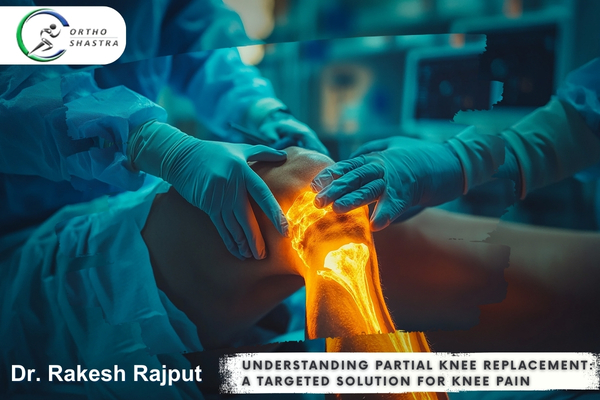
If you’ve been told that “bone-on-bone” arthritis is the cause of your knee pain, your first thought might be that you need a total knee replacement. However, for many patients, the damage is limited to just one part of the joint.
In these cases, a Partial Knee Replacement (also known as Unicompartmental Knee Arthroplasty) may be the superior choice, offering a quicker recovery and a more “natural” feeling knee.
What is a Partial Knee Replacement?
The knee is divided into three major compartments:
- Medial (the inside part of the knee)
- Lateral (the outside part)
- Patellofemoral (the front of the knee under the kneecap)
A total knee replacement replaces all three. A partial knee replacement only replaces the single compartment that has been worn down by osteoarthritis. By removing only the damaged cartilage and bone and replacing it with metal and plastic components, the healthy bone, cartilage, and all your ligaments (including the ACL and PCL) are preserved.
[Image comparing a total knee replacement vs a partial knee replacement]
The Benefits: Why “Partial” is Often Better
Because the surgery is less invasive than a total replacement, patients often experience several key advantages:
- Faster Recovery: Most patients walk the same day as surgery and return to normal activities weeks sooner than total knee patients.
- More Natural Movement: Because your natural ligaments (ACL/PCL) are kept intact, the knee often feels more stable and “normal” during movement.
- Less Blood Loss & Pain: Smaller incisions and less bone removal typically result in less post-operative discomfort.
- Reduced Hospital Stay: Many partial knee replacements are now performed as outpatient procedures, allowing you to recover in the comfort of your home.
Are You a Candidate?
Not everyone with knee pain is a candidate for a unicompartmental procedure. Surgeons typically look for the following criteria:
| Feature | Ideal Candidate |
| Pain Location | Confined to only one side/part of the knee. |
| Ligament Health | Intact ACL and stable ligaments. |
| Range of Motion | Still possesses a good degree of flexibility in the knee. |
| Inflammation | Non-inflammatory arthritis (Osteoarthritis, not Rheumatoid). |
Note: If you have inflammatory arthritis or damage in multiple compartments, a total knee replacement remains the “gold standard” for long-term pain relief.
What to Expect During Recovery
The recovery timeline for a partial knee replacement is significantly compressed:
- Weeks 1-2: Focus on swelling management and basic physical therapy. Most patients use a cane or walker for only a few days.
- Weeks 3-6: Significant improvement in strength. Many patients return to driving and sedentary work.
- Months 3+: Return to low-impact sports like golf, cycling, or swimming.
Conclusion
A partial knee replacement is a sophisticated, bone-sparing procedure that can bridge the gap between conservative treatments (like injections) and a total joint replacement. If your pain is localized and your ligaments are strong, this “precision” surgery could be your fastest ticket back to an active lifestyle.